Water Purifier: RO vs UV vs UF — Pick the Right One for Your Home
Water Purifier: RO vs UV vs UF (Pick Right)
Most Indian homes get mixed water sources—municipal supply some days, borewell on others. That’s why “Which purifier?” is a common headache. This guide gives you a crisp rulebook + a quick calculator so you can choose confidently, avoid over-buying, and set it up right.
Quick note: This is general, non-medical guidance. For health concerns, speak to a doctor or your local public health authority.
🧭 Summary
-
Choose RO if your TDS > 500 mg/L, taste is noticeably salty/bitter, or chemicals like fluoride/nitrate exceed BIS drinking-water limits. Consider RO + UV/UF if microbes may be present.
-
Choose UV (with pre-filters) if TDS is ≤ 500 mg/L but you need disinfection (municipal supply, overhead tanks). UV kills/inactivates microbes but doesn’t remove salts/chemicals.
-
Choose UF (gravity/inline) if TDS is ≤ 500 mg/L and you mainly need to remove silt/turbidity and cysts (useful during monsoon or for visibly muddy supply). No electricity required; doesn’t remove dissolved salts.
-
Avoid RO where TDS ≤ 500 mg/L unless you’ve confirmed specific chemical problems (e.g., fluoride > 1.0 mg/L, nitrate > 45 mg/L) or taste/odour issues you can link to dissolved solids.
-
Always check BIS limits for key parameters and keep a simple evidence bundle: TDS reading, photos of test strips/lab report, and service tickets.
(References: BIS IS 10500 drinking-water specs; CPCB/NGT notes on RO usage; WHO guidance on microbial safety and UV effectiveness. ScienceDirect+3Central Pollution Control Board+3Central Pollution Control Board+3)
🧰 Before you start
Who this is for: Indian households deciding between RO / UV / UF or combinations (RO+UV/UF), including renters and small offices.
What you’ll need (5-minute check):
-
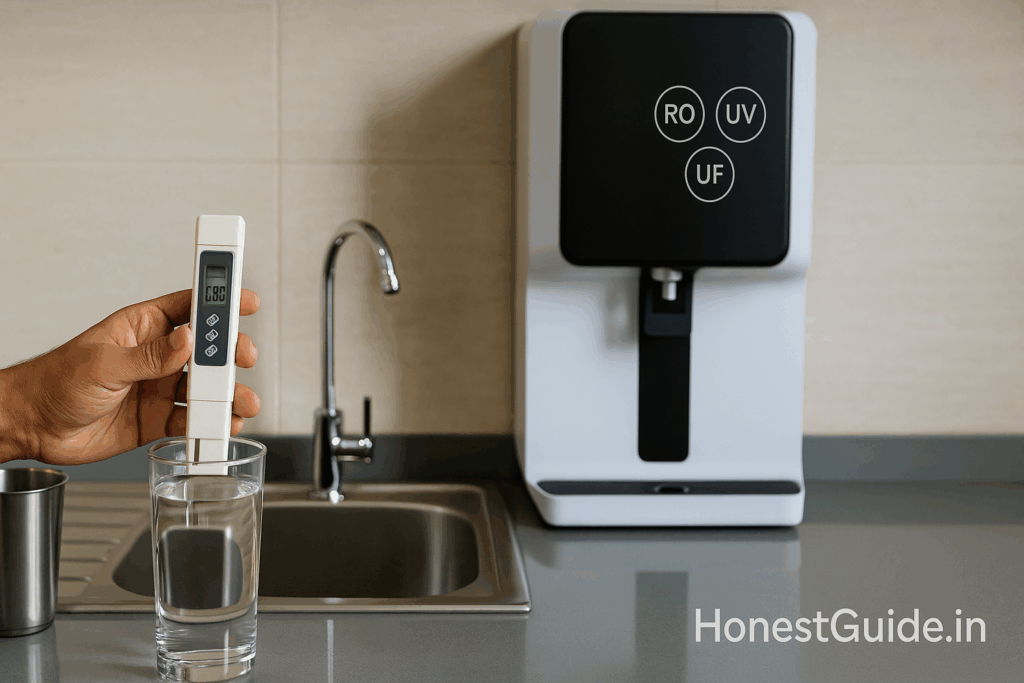
A pocket TDS meter (₹300–₹800) or a recent water test report.
-
Your water source info (municipal/borewell/tanker; single or mixed).
-
A quick look at taste/odour and turbidity (is water visibly cloudy?).
-
Any local issues: fluoride belts, nitrate-prone areas, old pipelines, monsoon contamination.
Typical costs (hardware only):
-
UF (gravity/inline): ₹1,500–₹6,000
-
UV (with sediment/carbon): ₹6,000–₹12,000
-
RO (often with UV/UF): ₹9,000–₹25,000+
-
AMC/filters yearly: ₹1,200–₹5,000 (brand, usage, and water quality dependent)
Why TDS matters: BIS IS 10500 sets acceptable TDS at 500 mg/L (permissible up to 2000 if no alternate source). Above 500, RO is typically justified; at or below, prefer UV/UF unless specific chemicals exceed limits. Central Pollution Control Board+1
🔢 Decision Helper + “Paper Calculator” (3 steps)
Step 1 — Measure TDS
-
Run the tap 30–60 seconds; fill a glass; measure with a TDS meter.
-
Note the range you usually see (many homes get mixed sources across days).
Step 2 — Check visible/microbial risk
-
Cloudy water / tank cleaning overdue / monsoon leaks / frequent stomach upsets → treat as microbial risk = YES.
-
If you have a recent lab/strip test showing microbes, treat as YES.
Step 3 — Decide using the matrix
| Your water condition | Pick | Why |
|---|---|---|
| TDS > 500 mg/L (salty/bitter taste common) | RO (add UV/UF if microbial risk) | RO reduces dissolved salts & many chemicals; UV/UF adds disinfection/turbidity control. Central Pollution Control Board |
| TDS ≤ 500 mg/L + microbial risk = YES | UV + pre-filters (sediment + carbon). UF optional for turbidity | UV inactivates bacteria/viruses; pre-filters protect the UV chamber and improve taste/odour. WHO Apps+1 |
| TDS ≤ 500 mg/L + microbial risk = LOW, but water looks muddy/has fine silt | UF (gravity or inline) | UF strains out turbidity, cysts, many microbes; doesn’t remove salts; no power needed. Ampac1 |
| Specific chemicals over BIS limits (e.g., fluoride > 1.0 mg/L, nitrate > 45 mg/L) | RO (often with activated carbon + post-treatment) | RO can reduce fluoride/nitrate; verify with a lab test and check BIS limits. Central Pollution Control Board |
| Already softened water / low TDS municipal but you want microbial safety | UV (sometimes UV+UF) | Disinfection without stripping minerals; keep TDS as is. WHO Apps+1 |
Heads-up on rules: Environmental bodies in India have flagged unnecessary RO in low-TDS areas due to water wastage and mineral loss, and courts have considered restrictions—policy status has seen stays and revisions. Use RO when TDS > 500 or specific chemicals are high. Central Pollution Control Board+1
🧪 Mini “worked examples”
-
Mumbai flat (municipal, TDS ~120, monsoon leaks): UV (+ sediment/carbon). UF optional for turbidity spikes.
-
Gurugram villa (borewell mix, TDS 750, hardness high): RO + UV/UF. Add remineraliser if taste becomes flat.
-
Small office (RO in pantry; incoming TDS 180, tank hygiene poor): UV with good pre-filters + strict tank cleaning; RO not needed unless chemicals exceed limits.
-
Fluoride-belt town (lab shows F = 1.6 mg/L, TDS 420): RO justified due to fluoride, even though TDS ≤ 500; confirm post-install results.
🧰 What each tech actually does (and doesn’t)
| Feature | RO | UV | UF |
|---|---|---|---|
| Removes dissolved salts/chemicals (TDS, fluoride, nitrate, some heavy metals) | ✅ (primary use) | ❌ | ❌ |
| Disinfects microbes (bacteria/viruses/protozoa) | ⚠️ (indirect; often paired with UV) | ✅ (inactivates) | ✅ (retains) |
| Handles turbidity/silt | ✅ (with pre-filters) | ❌ (needs clear water) | ✅ |
| Electricity needed | ✅ | ✅ | ❌ |
| Taste impact | Can taste “flat”; post-treatment helps | Neutral | Neutral |
| Wastewater | Produces reject; modern units specify recovery | None | None |
| Typical use-case | High TDS / chemical issues | Low TDS + microbial risk | Low TDS + turbidity |
(RO product marking, recovery rating, and limits are covered under BIS IS 16240 for RO-based PoU systems.) BIS
🔧 Steps to set up the right purifier (short & practical)
-
Measure TDS on 3 different days. Note the range and source.
-
Check tank hygiene and pipelines. Clean tanks/flush lines; fixes many “taste/odour” issues.
-
If TDS > 500 mg/L or chemicals exceed BIS limits, shortlist RO (with UV/UF add-ons). Else, shortlist UV/UF. Central Pollution Control Board
-
Confirm cartridge availability & AMC for your city (ask for part numbers and costs).
-
Check rated recovery on RO (ask: “What’s the recovery % and litres/hour?”; many home ROs achieve ~35–60% recovery depending on feed TDS/pressure—lower reject is better). BIS
-
Ask for a TDS/flow demo at installation. Record pre- and post-TDS.
-
Plan waste-water reuse (mopping, flushing, gardening with caution).
-
Schedule filter reminders (sediment 6–12 months, carbon 6–12 months, RO membrane 18–36 months—ranges vary by water quality and usage; check your model’s manual).
-
Keep an evidence bundle (photos of readings, service slips, part numbers).
-
Re-test seasonally (especially pre-/post-monsoon or when supply source changes).
📋 Checklist (copy-paste)
-
TDS measured on 3 days (note range)
-
Source noted (municipal / borewell / tanker / mixed)
-
Microbial risk judged (tank state, monsoon leaks, lab/strip test)
-
Tech shortlisted via matrix (RO vs UV vs UF)
-
RO recovery % and rated LPH obtained (if RO chosen)
-
Cartridge/AMC availability and costs confirmed
-
Install with pre-filters and pressure checks
-
Record pre/post TDS; taste check
-
Plan reject-water reuse (if RO)
-
Set filter change reminders; re-test seasonally
⚠️ Red flags & common mistakes
-
Buying RO for low-TDS municipal water → Wastage + flat taste → Use UV/UF unless chemicals are high. Central Pollution Control Board
-
Using UV on muddy water → Poor disinfection (UV needs clear water) → Add sediment filtration or switch to UF+UV. ScienceDirect
-
Skipping tank cleaning → Recurring smell/diarrhoea → Clean tanks 3–6 months; disinfect pipelines.
-
Ignoring recovery rating on RO → High reject water → Pick models with higher recovery; maintain inlet pressure. BIS
-
Not testing fluoride/nitrate in known hotspots → Health risk persists → Do a simple lab test; compare with BIS limits. Central Pollution Control Board
🗣️ Mini-scripts (use with shops/technicians)
-
At the store:
“My incoming TDS is ~[value] mg/L and source is [municipal/borewell/mixed]. I need a purifier that meets BIS limits. What’s your RO recovery % and filter costs? Do you have UV/UF-only options for low TDS?” -
At installation:
“Please record pre- and post-TDS and show me the UV lamp status/UF membrane orientation. Note the filter part numbers on my invoice.” -
For service calls:
“Water flow is low and taste changed. Please check sediment/carbon clogging, inlet pressure, and RO recovery setting. Update my service record with readings.”
🧗 Escalation path (with links)
-
Brand customer care → ask for a visit report with readings and parts replaced.
-
Dealer/Brand grievance (email/web form) → attach TDS/photos, invoices, ticket numbers.
-
Consumer Helpline (Dept of Consumer Affairs) for defective goods/deficient service.
-
State Pollution Control Board/Local Water Board for systemic supply contamination.
-
BIS (standards/product marking queries) for IS 10500 and IS 16240 references.
(Use official portals: “National Consumer Helpline,” “BIS Care,” your State PCB website.)
❓ FAQs
1) Is RO harmful if my TDS is already low?
Not harmful per se, but often unnecessary: it wastes water and may make taste “flat.” Use RO only when TDS > 500 or specific chemicals are high. Central Pollution Control Board
2) Does UV make water mineral-free?
No. UV disinfects; it doesn’t change TDS or remove chemicals. WHO Apps+1
3) Can UF remove viruses?
UF typically removes bacteria and many protozoa/cysts and reduces some viruses depending on membrane rating, but it doesn’t remove dissolved salts. For high certainty on viruses, UV or RO+UV combinations are common. Ampac1
4) What are BIS limits I should care about at home?
For quick decisions: TDS 500 mg/L (acceptable), Fluoride 1.0 mg/L (acceptable; 1.5 max), Nitrate 45 mg/L; check the full IS 10500 table for more parameters. Central Pollution Control Board
5) My city supply is fine most days but turns muddy in monsoon.
Keep UF or good sediment filtration in the chain. If microbes are a concern, add UV.
6) How to handle RO reject water?
Collect for mopping/flushing. Avoid using on delicate plants or as drinking water. Check your model’s recovery % and maintain inlet pressure to keep reject down. BIS
7) Are there rules against RO in low-TDS areas?
Indian environmental authorities have recommended discouraging RO where TDS ≤ 500; there have been legal proceedings and interim stays. Treat this as: choose RO only when justified by TDS/chemicals. Central Pollution Control Board+1
8) Should I add a remineraliser after RO?
If taste feels flat (very low post-TDS), a remineraliser/post-carbon can help. Ensure post-TDS stays reasonable (commonly 80–200 mg/L depending on source).
📚 Sources (official/primary)
-
Bureau of Indian Standards (BIS) — IS 10500: Drinking-Water Specification (limits for TDS, fluoride, nitrate, etc.). Central Pollution Control Board
-
Bureau of Indian Standards — IS 16240 (RO-based PoU systems): product manual notes on recovery rating, capacity, and markings. BIS
-
Central Pollution Control Board (CPCB) — 2019 report on RO usage vs TDS (recommend RO > 500 mg/L; alternatives below). Central Pollution Control Board
-
World Health Organization (WHO) — Guidelines for Drinking-Water Quality (microbial safety, UV concepts). WHO Apps
-
Technical overview on UV disinfection (UV is a point treatment; needs clear water). ScienceDirect
-
Legal context news (Supreme Court stay on NGT’s blanket restriction; status may evolve). Business Standard