Apartment Power Backup: Choose the Right Option (with Costs)
Apartment Power Backup: Options & Costing
Power cuts are rare in some cities and daily in others. In apartments, you also have society rules to respect and limited space. This guide cuts through the noise—what to pick (and avoid), how much it’ll cost, how long it’ll run, and whom each option suits in India.
🧭 Summary
-
Choose Society DG (generator) connection if your building already provides it and you mainly need lifts, common lights, and a low-amp supply in your flat during outages. Pros: automatic, no setup. Cons: noisy, fuel surcharges.
-
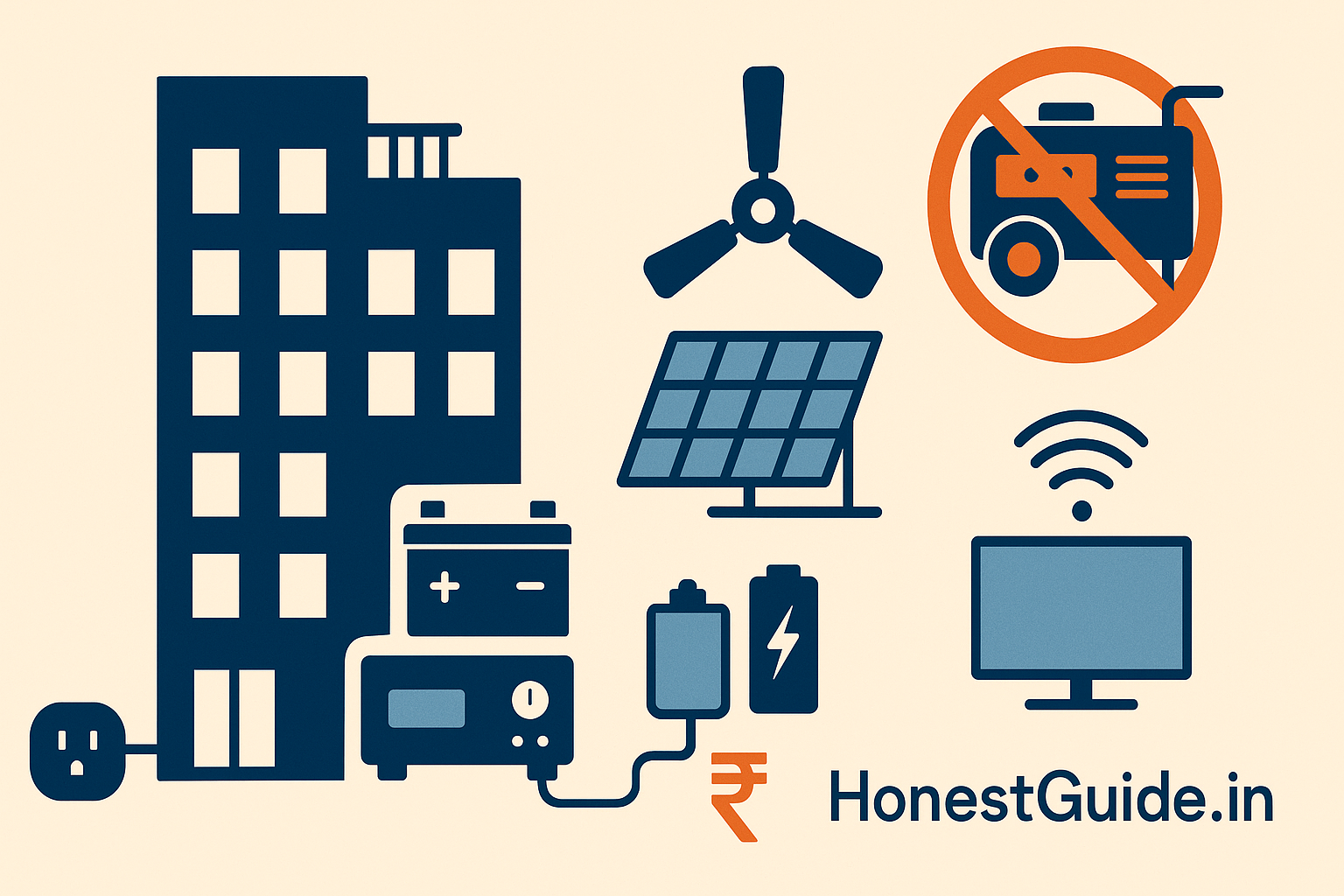
Choose Home Inverter + Tubular Lead-acid batteries for the best value 2–6 hours backup for lights, fans, Wi-Fi, TV, laptops, and maybe fridge. ₹30k–₹60k typical.
-
Choose Lithium (LiFePO₄) Inverter/Battery if you want compact, faster charge, longer life (5–10 years) and low maintenance. ₹55k–₹1.5L for 1–3 kWh.
-
Choose Online UPS (1–3 kVA) only for sensitive gear (desktops/servers, medical devices) needing zero transfer time. ₹15k–₹60k+; shorter runtime unless you add batteries.
-
Choose Portable Power Station (lithium “power bank for home”) if you’re a renter who wants plug-and-play and easy move-out. ₹40k–₹1.2L for ~0.8–2 kWh.
-
Choose Solar Hybrid (with/without panels) if you own the flat and your society permits rooftop/balcony PV. Great for long cuts and bill savings. Inverter-battery ₹40k–₹90k; add 1–3 kW PV ₹60k–₹2.2L before subsidy.
-
Avoid backing up heavy loads (AC, geyser, oven) in apartments—costly and impractical.
⚖️ Comparison table (apartment-friendly options)
| Option | What it runs well | Typical upfront (₹) | Running cost | Noise | Maintenance | Lifespan (battery) | Who it suits |
|---|---|---|---|---|---|---|---|
| Society DG backup | Common areas + limited in-flat load | 0 setup (society charges apply) | Diesel pass-through | High (outside) | Society handled | N/A | Residents in DG-enabled societies |
| Inverter + Tubular Lead-acid (900–1500 VA, 2×150–200Ah) | Fans, lights, Wi-Fi, TV, laptops; fridge (check surge) | 30,000–60,000 | Low (electricity to charge) | Silent | Top-up water, vent | 3–5 yrs | Most 2–3BHK flats |
| Lithium (LiFePO₄) inverter/battery 1–3 kWh | Same as above; better cycle life | 55,000–1,50,000 | Low | Silent | Minimal | 6–10 yrs | Owners/long-term renters |
| Online UPS 1–3 kVA + ext. batteries | Desktops, POS, sensitive devices | 15,000–60,000+ | Moderate | Fan noise | Occasional | 3–10 yrs (by battery) | Work-from-home, clinics |
| Portable Power Station 0.8–2 kWh | Router, laptops, 1–2 fans/LEDs, TV | 40,000–1,20,000 | Low | Silent | Minimal | 5–10 yrs | Renters; no wiring |
| Solar Hybrid (1–3 kW PV + 2–5 kWh batt.) | Daytime heavy + night essentials | 1,00,000–3,50,000 (pre-subsidy) | Very low | Silent | Panel cleaning | 6–10 yrs (battery) | Owners; long outages |
Notes: Prices are street ranges for reputable makes in India and vary by city/tax. Always get 2–3 quotes.
🧮 Sizing: quick calculator (with worked examples)
Step 1 — List essential loads (Watts):
-
LED light: 8–12 W each
-
Ceiling fan: 60–75 W (inverter fans ~35–45 W)
-
Wi-Fi router/ONT: 8–15 W
-
Laptop on charge: 40–90 W
-
LED TV 32–43″: 40–80 W
-
Fridge: 100–180 W running, 400–800 W start surge (compressor)
Step 2 — Add up running watts (ignore AC/geyser/oven).
Step 3 — Decide backup hours you need on a bad day (e.g., 3–4 h).
Step 4 — Battery energy needed (Wh) = Load (W) × Hours ÷ 0.8 (inverter/battery losses).
Step 5 — Convert to battery capacity:
-
12 V systems: Ah = Wh ÷ 12
-
24 V systems: Ah = Wh ÷ 24
(V depends on inverter—higher V for higher loads is better.)
Example A (2BHK essentials, 4 hours):
2 fans (2×70) + 6 LEDs (6×10) + router (10) + TV (60) + 1 laptop (60) = 290 W
Wh needed = 290 × 4 ÷ 0.8 ≈ 1,450 Wh
At 24 V: Ah ≈ 1,450 ÷ 24 ≈ 60 Ah usable. With lead-acid (don’t discharge below ~50%), plan 120 Ah at 24 V → 2×120Ah (or 2×150Ah for headroom). Inverter rating 1–1.5 kVA.
Example B (add fridge, 3 hours):
Add 150 W running (surge ~600 W). New load ≈ 440 W
Wh = 440 × 3 ÷ 0.8 ≈ 1,650 Wh
At 24 V: Ah ≈ 69 Ah usable → 2×150Ah lead-acid or ~2 kWh lithium. Inverter 1.5–2 kVA to handle surge.
Tip: Put the fridge on backup only if cuts >2 h and wiring allows a dedicated circuit.
🗺️ Scenarios (choose what fits you)
1) Renter (1BHK/2BHK, moderate cuts)
Pick portable power station (1–1.5 kWh) or inverter + single 150Ah battery if landlord allows. No civil work, easy to move.
Budget: ₹25k–₹80k.
Wiring: Use a changeover switch or manual plug-and-play sub-strip for essentials.
2) Owner (2–3BHK, frequent 2–4 h cuts)
Pick inverter (1–1.5 kVA) + 2×150–200Ah tubular or 2–3 kWh lithium. Wire an essential circuit (fans/lights/Wi-Fi/TV).
Budget: ₹40k–₹1.2L.
3) Work-from-home professional
Desktop + modem need online UPS (1–2 kVA) for no flicker + separate home inverter for the rest.
Budget: ₹50k–₹1L combined.
4) Senior parents (low load, long cuts)
Lithium 1–2 kWh or lead-acid 2×150Ah for 4–6 h with minimal upkeep. Prefer inverter fans to stretch runtime.
5) Owner with terrace access
Hybrid solar inverter (3 kVA) + 2–4 kWh battery + 1.5–3 kW PV. Cuts bills and gives backup. Confirm society by-laws and DISCOM rules.
🧩 What “UPS vs Inverter” really means
-
Home UPS/Inverter: Both convert battery DC→AC for home loads. “UPS” in home context means faster switchover (10–20 ms) vs basic inverter (20–40 ms). For TVs/routers it’s fine; for desktops, prefer online UPS (0 ms).
-
Online/Double-conversion UPS: Always on; cleans power; ideal for critical electronics; usually paired with external batteries for longer runtime.
🛠️ Installation & wiring notes (apartment-safe)
-
Ask your electrician to create an “essentials” sub-circuit from your distribution board (fans, lights, router, TV points).
-
Keep batteries in a ventilated corner, away from bedrooms; spill-proof trays for lead-acid.
-
Dedicated MCBs and correct earthing are non-negotiable.
-
For fridges, confirm inverter surge rating and use a separate dedicated line.
-
Check society rules on balcony/utility placement and solar panel mounting.
💸 Cost breakdown (2025 street ranges)
Lead-acid tubular batteries (12 V):
-
150Ah: ₹12,000–18,000 each
-
200Ah: ₹16,000–22,000 each
Inverters (sine wave):
-
900–1100 VA: ₹6,000–11,000
-
1.5–2 kVA (24–48 V): ₹12,000–28,000
Lithium (LiFePO₄) packs:
-
1 kWh: ₹35,000–55,000
-
2–3 kWh: ₹65,000–1,30,000
Online UPS:
-
1–2 kVA units: ₹12,000–35,000 (unit) + batteries
Portable power stations:
-
0.8–2 kWh: ₹40,000–1,20,000
Solar add-ons (indicative):
-
Hybrid inverter 3 kVA: ₹30,000–60,000
-
PV panels: ₹28–40/Wp (before subsidy)
-
Mounting, wiring, protections: ₹20,000–60,000 by size
Heads-up: Prices vary by brand, warranty, and city; check official specs and current subsidy rules.
⚠️ Pitfalls & how to avoid them
-
Under-sizing battery → Short runtime. Fix: Calculate Wh (see section) and add 20–30% headroom.
-
Ignoring surge current → Inverter trips when fridge starts. Fix: Choose inverter with 2–3× surge rating; use soft-start fridge or keep it off backup.
-
Poor ventilation for lead-acid → Smell/corrosion. Fix: Ventilate; use sealed VRLA or go lithium.
-
Mixing old and new batteries → Fast failure. Fix: Replace as a set.
-
No earthing/MCB → Safety risk. Fix: Certified electrician; test earthing.
-
Backing up AC/geyser → Massive cost. Fix: Keep these on grid only.
-
Balcony solar without permissions → Society disputes. Fix: Written approval; follow DISCOM/BIS standards.
🗣️ Mini-scripts (use these while buying)
To electrician/installer
-
“Please size for 290–450 W continuous with 2–3× surge. Show the MCB ratings you’ll use and where the changeover sits.”
-
“Wire an essentials sub-circuit: 2 fans, 6 lights, router, TV. The fridge should be on a separate protected line.”
-
“Confirm earthing value and share photos of terminal torque and fuse/isolator used.”
To battery/inverter seller
-
“What’s the cycle life at 80% DoD and the warranty terms (pro-rata vs full)?”
-
“Give me the continuous and surge rating of this inverter and the efficiency at 30–50% load.”
-
“Is the battery IS-marked and recommended charging bulk/float voltages?”
To society/RWA
-
“Are there restrictions on battery placement or solar mounting? Do you allow net-metering or only gross? Please share the by-laws extract.”
❓ FAQs
Can I run a fridge on home inverter?
Yes, if the inverter supports the surge and your wiring isolates essentials. Expect reduced runtime; consider keeping the fridge closed during cuts.
Lead-acid vs lithium for apartments?
Lead-acid is cheaper upfront, heavier, needs water top-ups and ventilation. Lithium (LiFePO₄) costs more but is lighter, charges faster, and lasts longer.
How many hours will 2×150Ah give?
At 24 V, that’s ~3,600 Wh gross. Assuming 50% usable for lead-acid and ~85% inverter efficiency → usable ≈ 1,530 Wh. With a 300 W load, expect ~5 hours.
Is online UPS necessary for Wi-Fi/TV?
Not necessary. A sine-wave home inverter’s 20–40 ms transfer is fine. Online UPS is for zero-transfer needs like desktops/servers.
Can I put the unit on the balcony?
Only if sheltered from sun/rain and allowed by society. Keep batteries off the floor on a tray; avoid bedrooms.
What about fire safety?
Use correct cable sizes, MCB/fuses, proper earthing, and certified installers. Keep clear space around batteries; avoid overloading.
Will solar pay back in an apartment?
If you have terrace rights and decent sun, a 1.5–3 kW system can cut bills meaningfully. Without panel space, a hybrid inverter + battery still helps for backup, but savings depend on tariff.
📚 Sources (official/primary)
-
Bureau of Energy Efficiency (BEE) — appliance efficiency norms, inverter/UPS efficiency guidance and standards.
-
Bureau of Indian Standards (BIS) — relevant product safety/installation standards for inverters, batteries, and wiring.
-
Manufacturer specification sheets — inverter continuous/surge ratings, battery capacity and cycle life (use brand’s official PDFs).
-
DISCOM/MNRE portals — for solar rooftop eligibility, safety, metering, and current subsidy rules in your state.
Disclaimer: This is general guidance for typical Indian apartments. Always follow local electrical codes, society by-laws, and certified installer advice for safety.