Read Your Water Report & Pick the Right Purifier
Read Your Water Report & Choose Purifier
Most homes buy a purifier first and read the water report later. That’s why many end up with the wrong machine—wasting water, money, and still drinking poor-quality water. This guide shows you how to read a basic water report (or a lab test) and choose a purifier that actually fits your supply in India.
🧭 Summary
-
Outcome: Match your purifier to your water: RO only if TDS or specific chemicals are high; UV/UF if microbial risk; simple filters if both are low.
-
Key numbers: BIS acceptable TDS ≤ 500 mg/L (ppm); permissible up to 2000 mg/L if no alternate source. Fluoride ≤ 1.0 mg/L; Nitrate ≤ 45 mg/L; Free residual chlorine at tap ≥0.2 mg/L when chlorinated. Law Resource
-
Costs: Basic UF/gravity ₹2k–5k; UV/UF ₹6k–12k; RO+UV ₹10k–25k (+ ₹2k–6k yearly for cartridges/AMC).
-
Top pitfall: Installing RO where TDS is already low (<500) — wastes water and strips minerals. An NGT restriction was stayed by the Supreme Court in Mar 2022, but the spirit (avoid needless RO) still stands. Business Standard
-
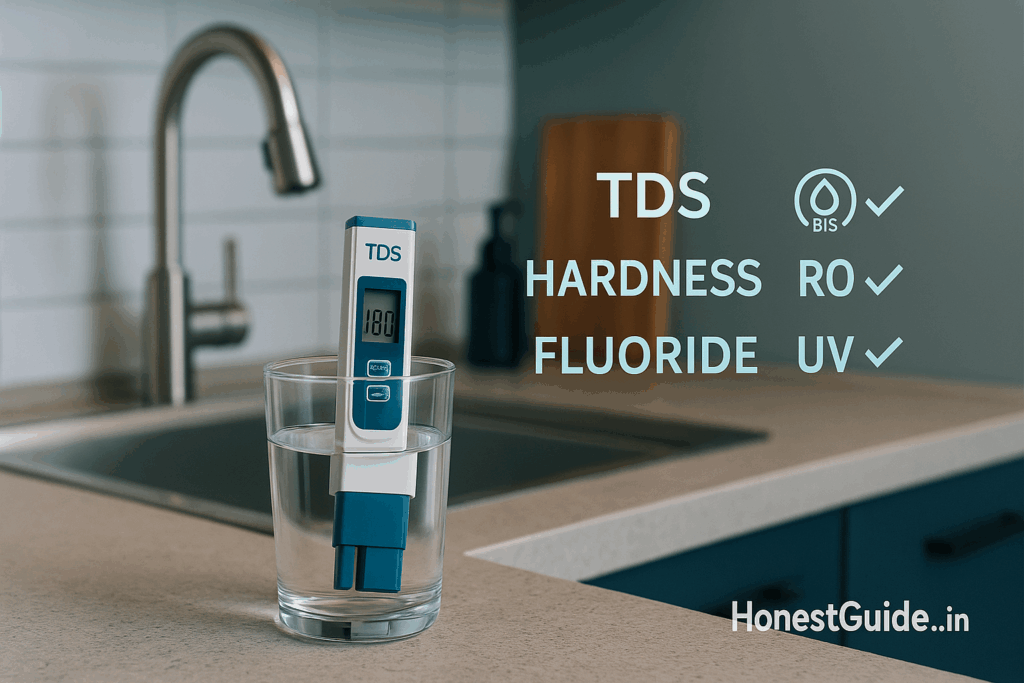
What to do now: Get a recent report (or measure with a ₹300 TDS pen), note TDS + fluoride/nitrate/iron + smell/turbidity, then use the decision table below.
🧰 Before you start
Who this is for: Renters, owners, RWAs, and small offices on municipal, borewell, or tanker water.
What you need (any two help):
-
Latest water report from your local water board/RWA/tanker supplier (look for TDS, hardness, fluoride, nitrate, iron, residual chlorine, coliform).
-
A TDS meter reading at your kitchen tap (morning sample).
-
Visual cues: colour/turbidity, metallic/salty taste, white scaling on kettles (hardness).
Standards to keep in mind (BIS IS 10500:2012):
-
TDS: acceptable ≤ 500 mg/L; permissible up to 2000 mg/L in absence of alternate source.
-
Hardness (as CaCO₃): acceptable 200 mg/L (permissible 600).
-
Fluoride: 1.0 mg/L (permissible 1.5).
-
Nitrate: 45 mg/L (no relaxation).
-
Iron: 0.3 mg/L (no relaxation).
-
Free residual chlorine at consumer end when chlorinated: ≥0.2 mg/L (≥0.5 mg/L if viral risk). Law Resource
Quick note on the RO “ban”: The NGT asked to prohibit RO where TDS <500 mg/L to curb wastage and de-mineralisation, but the Supreme Court stayed that direction in March 2022. So RO isn’t banned nationwide; still, you should avoid RO unless your water requires it. Business Standard
🔟 Choose using this “report → purifier” tool
Read your numbers (or use reasonable guesses if you lack a full report):
Step 1 — Note your TDS
-
≤ 300 mg/L: Generally low-salinity water (typical treated municipal).
-
301–500 mg/L: Borderline; acceptable per BIS.
-
> 500 mg/L: High TDS; consider RO if taste/salinity or other chemicals (fluoride, nitrate, chloride) also high. Law Resource
Step 2 — Check microbial risk
-
Any coliform/E. coli detected? Or frequent stomach upsets? Or intermittent supply/overhead tank hygiene issues? Then disinfection (UV or chlorination) is essential.
Step 3 — Check specific chemicals
-
Fluoride >1.0 mg/L (or brown teeth in locality), Nitrate >45 mg/L (borewell/farming areas), Iron >0.3 mg/L (reddish stains), Hardness >200 mg/L (white scaling). These push you toward RO (for dissolved inorganics) plus UV (for microbes) and pre-treatment (iron/softening). Law Resource
Step 4 — Match to a purifier type
| Your water situation | Pick this | Why |
|---|---|---|
| TDS ≤300; chlorinated municipal; no coliform; mild taste | UF (gravity) or simple sediment + carbon under-sink | Removes dust/chlorine taste; keeps minerals; zero wastewater |
| TDS ≤300; microbial risk (storage tanks, intermittent supply) | UV + UF (sometimes called UV+UF) | UV inactivates germs; UF holds cysts; no mineral loss |
| TDS 301–500; taste is fine; no specific chemicals | UV/UF (not RO) | Still within BIS acceptable; avoid needless RO |
| TDS >500 or Fluoride >1.0 or Nitrate >45 or Chloride/Hardness very high | RO + UV (+ UF/MTDS) with proper pre-filter | RO reduces dissolved salts/chemicals; UV handles microbes; MTDS/mineraliser for taste |
| High iron (>0.3) or visible rust | RO system with iron pre-filter (or separate iron cartridge) | Prevents membrane fouling, improves taste/staining issues |
| Turbid water (muddy post-monsoon) | Sediment (5µm) + UF, add RO only if TDS/chemicals demand | Clarifies water; RO not for mud alone |
| Borewell/tanker mix; numbers fluctuate | Modular stack: sediment → carbon → UV/UF; add RO only if TDS persistently >500 | Lets you reconfigure with seasons/suppliers |
(Thresholds per BIS IS 10500 acceptable/permissible limits; RO is a tool for high dissolved solids/chemicals, not a default.) Law Resource
📐 Worked examples (India-realistic)
Example A — Treated municipal (flat in Pune)
-
TDS: 180 mg/L; Residual chlorine: 0.3 mg/L; No coliform; Hardness 120; Iron <0.1.
-
Pick: UV/UF optional; even a sediment + carbon combo suffices. Avoid RO.
-
Why: Already within BIS acceptable; chlorine at tap is adequate for disinfection. Law Resource
Example B — Borewell (peripheral Bengaluru)
-
TDS: 780 mg/L; Hardness 350; Iron 0.6; Fluoride 0.9; Occasional odour.
-
Pick: RO + UV with iron pre-filter and sediment + carbon stages.
-
Notes: Expect reject water; set up reuse (mopping, toilet flush). Maintain cartridges to protect the RO membrane.
Example C — Tanker mix (Gurugram RWA)
-
TDS fluctuates 280 → 650 mg/L across weeks; coliform absent; hardness high during summers.
-
Pick: Modular chain (sediment → carbon → UV/UF), with an RO module that can be enabled when TDS climbs above ~500 for long spells.
🧩 Interpret your lab report like a pro
-
TDS (mg/L): Taste/salinity proxy. BIS acceptable ≤500; permissible up to 2000 if no alternate. High TDS often means hardness and chloride/sulphate are up too. Law Resource
-
Hardness (as CaCO₃): Acceptable 200, permissible 600. Scaling on taps/kettles? Use anti-scalant/cartridge; RO if overall TDS is high. Law Resource
-
Fluoride: Aim ≤1.0; above that, RO helps (with suitable cartridges). Law Resource
-
Nitrate: Must be ≤45. High in farming belts; RO addresses it. Law Resource
-
Iron: Keep ≤0.3. Use iron pre-filter if higher, else your RO membrane will choke. Law Resource
-
Residual chlorine: If your system is chlorinated, you should see ≥0.2 mg/L at the tap; if not, UV is a good safety net. Law Resource
🧪 Limitations & safety
-
RO reject water: Depending on model and feed water, you may see 1:1 to 1:3 product:reject ratios. Route reject to mopping/flush/utility; never to drinking. (Check your manufacturer’s spec.)
-
Minerals & taste: RO reduces all dissolved solids (good and neutral). Many units add a post-RO mineraliser/MTDS to improve taste; this isn’t a substitute for naturally balanced water.
-
Microbial safety: UV needs clear water (low turbidity) to work well. Keep cartridges clean and replace on schedule.
-
Legal context: The NGT’s push to restrict RO below 500 mg/L was to cut wastage; implementation is stayed by the Supreme Court (Mar 2022). Always prioritise water quality needs over marketing. Business Standard
📋 Checklist (copy-paste)
-
Get latest report (water board/RWA/tanker) or test (TDS, hardness, iron, fluoride, nitrate, coliform).
-
Measure TDS at kitchen tap (morning, flushed).
-
Check tank hygiene; clean overhead/underground tanks.
-
Map your numbers to the table above; pick purifier type.
-
Plan pre-filters (sediment 5µm, carbon; iron if needed).
-
If going RO, plan reject reuse (mopping/flush).
-
Book installation with proper pressure checks and TDS before/after.
-
Save invoice, model no., filter schedule; set reminders for cartridges.
-
Re-test water every 6–12 months or after supply changes.
⚠️ Red flags & common mistakes
| Mistake | What goes wrong | Fix |
|---|---|---|
| Buying RO “by default” | Unneeded wastage; flat taste | Use RO only if TDS/chemicals are high or taste is bad |
| Ignoring iron | Membrane clogs early | Add iron pre-filter (or separate iron cartridge) |
| UV on turbid water | Germs survive shadowing | Add sediment/UF before UV |
| Skipping cartridge changes | Germ breakthrough, taste issues | Follow manufacturer hours/months; keep receipts |
| No tank cleaning | Post-treatment re-contamination | Clean OHT/UGT 3–6 monthly; ensure lids/seals |
| No reject reuse (RO) | 100–500 litres/day wasted in big households | Route to toilet flush/utility; monitor ratio |
🗣️ Templates & scripts
Ask your RWA/water supplier for a report (WhatsApp/Email)
Subject: Water quality report request – {{Your Tower/Flat}}
Hi {{Name/Office}}, please share the latest lab report for our supply (parameters: TDS, hardness, iron, fluoride, nitrate, residual chlorine, coliform). We need this for selecting a suitable purifier as per BIS IS 10500. Thanks, {{Your Name}}, {{Flat No.}}.
Questions to ask the installer/technician (on call)
-
“What’s the feed TDS right now? And product TDS after installation?”
-
“What’s the rated recovery of this RO? How do I route reject to utility?”
-
“Do I need an iron/antiscalant pre-filter given my report?”
-
“What’s the cartridge schedule (months/hrs) and estimated yearly cost?”
-
“Show me how to sanitise and flush after filter changes.”
🧗 Escalation path (with links you can search)
-
Local Water Board/ULB quality cell — request official report and residual chlorine checks (search “{{Your City}} water board water quality report”).
-
Purifier brand — customer care → grievance/nodal (ask for email ticket).
-
Consumer help — National Consumer Helpline (1915) / NCH portal for unresolved service/AMC disputes.
-
District/State Consumer Commission — file via e-Daakhil for persistent defects or unfair charges.
-
Public health lab (state) — submit sample for an independent test if you suspect contamination.
❓FAQs
1) Is RO banned in India if my TDS is below 500?
No. An NGT restriction was stayed by the Supreme Court in March 2022. Use judgement: if TDS is already low and chemical limits are within BIS acceptable values, you usually don’t need RO. Business Standard
2) My TDS is 120, but water smells of chlorine. Do I need RO?
No. That smell is disinfection. Use a carbon filter to improve taste; add UV/UF if you worry about microbial risk.
3) What’s a good “output TDS” after RO?
There’s no magic number; aim for palatable taste and compliance with BIS for other parameters. Very low TDS (<50) can taste flat; many units allow MTDS/mineraliser adjustment.
4) Can UV replace chlorine?
UV treats at point of use; chlorine protects through the pipeline. If your supply is chlorinated, you should still see ≥0.2 mg/L at tap for network safety. UV is an extra barrier in your kitchen. Law Resource
5) Do I need a softener?
Only if hardness is high (scaling on taps/geysers). For drinking, RO (when justified) already reduces hardness. For whole-house, consider a softener sized to flow rates.
6) I’m on tanker water; numbers keep changing.
Use a modular setup (sediment → carbon → UV/UF) and enable RO only in seasons or weeks when TDS stays high.
7) How often should I test?
Once every 6–12 months, and after any change of source/season or if taste/odour shifts.
8) Does boiling replace a purifier?
Boiling kills microbes but doesn’t remove salts/chemicals. It’s a good emergency step, not a full-time solution.
📚 Sources
-
BIS IS 10500:2012 — Drinking Water Specification (limits for TDS, hardness, fluoride, nitrate, iron, residual chlorine). Law Resource
-
Supreme Court stay (Mar 2022) on NGT’s direction to prohibit RO below 500 mg/L TDS (context on legality; conservation intent remains relevant). Business Standard
-
MoHUA/CPHEEO “Drink from Tap”/water supply manual (planning & quality management context for urban supplies). Ministry of Housing and Urban Affairs
-
IIT Kanpur — Drinking Water Standards (summary table referencing IS 10500). Indian Institute of Technology Kanpur
-
Down To Earth explainer (2024) on TDS ranges and standards (contextual understanding; cross-checks BIS values). Down To Earth
Disclaimer: This is general guidance based on BIS standards and public rulings. For health concerns or contamination events, consult local authorities and qualified professionals.