Heatwave at Home: Fans vs Coolers vs AC (What to Choose)
Heatwave at Home: Fans vs Coolers vs AC
Indian summers can be brutal—especially on top floors and in west-facing flats. The big question is simple: will a high-efficiency fan, an evaporative air cooler, or an AC give you the best comfort for your money and climate? This guide gives clear “choose X if…” answers, Indian pricing logic, and humidity-wise picks so you don’t waste a season (or a lakh).
🧭 Summary
-
Choose a BLDC ceiling fan if your budget is tight, your city gets sticky monsoons, or you need whole-day airflow at the lowest running cost. Good BLDC models can draw ~28–35W at full speed vs ~70–80W old fans, so you can run them all day for little money. Beestar Label+2Crompton+2
-
Choose an air cooler if your summers are hot and dry (Jaipur, Nagpur, Indore before monsoon), you can keep windows slightly open, and you want air that actually cools without AC bills. Typical draw is ~100–200W (personal/tower) to ~150–270W (desert). Not ideal in coastal/humid cities. Mawady+3Symphony Limited+3Symphony Limited+3
-
Choose an inverter AC if you need assured cooling in any humidity, closed windows, and sleep-through-the-heat comfort. Look for higher ISEER star ratings on the BEE label; they signal better seasonal efficiency for Indian weather. Expect ~0.8–1.8 kW draw in typical 1–1.5-ton loads while running (varies with set temp/room/insulation). beeindia.in+2Down To Earth+2
-
Humid monsoon months (e.g., Mumbai, Kochi, Kolkata) reduce cooler effectiveness; fans + AC dehumidify better. IMD data shows high monsoon humidity across many cities, which is why coolers feel less effective then. The Times of India+2Mausam+2
-
A smart stack for many homes: BLDC fan year-round + air cooler for dry heat; add inverter AC for peak humid months or bedrooms if budget allows.
🧰 Before you start (what matters in India)
-
Climate & humidity: Air coolers shine in dry heat; ACs win in humid regions and during monsoon. Fans help everywhere but don’t lower air temperature. Symphony Limited
-
Room size & envelope: Match device to m² and check sun-facing walls, glass, top floor. The leakier/hotter the room, the more you’ll need AC or a larger cooler.
-
Power & bills: Use the BEE star label for ACs; pick higher ISEER to cut seasonal units. For fans, check BEE star rating (mandatory); BLDC saves big. Typical wattage: fan 28–75W, cooler 100–270W, AC 800–1800W+ (running). Sathya Electronics+5Beestar Label+5Beestar Label+5
-
Ventilation needs: Coolers need fresh air (slightly open windows) for evaporation; ACs need sealed rooms; fans don’t care, but cross-ventilation helps. Symphony Limited
-
Water availability (coolers): Keep tank filled; use clean water to reduce odour/mineral stains.
-
Allergies & air: ACs can dehumidify and filter; coolers add moisture (good in dry heat, not in damp spells).
🔎 Decision helper: quick steps to the right choice
-
Check your city & season.
-
Dry summer, low humidity: Try cooler first.
-
Humid/coastal or monsoon months: You’ll likely need AC (+ fans). The Times of India
-
-
Measure your room (m²).
-
Up to 12–14 m²: personal/tower cooler; 1 ton AC if sealed.
-
15–25 m²: desert cooler; 1.5 ton AC typical.
-
-
Look at your envelope.
-
Top floor / west sun / big windows → jump a size or move to AC.
-
-
Set your budget (₹).
-
BLDC fan ₹2–4k (per room)
-
Cooler ₹5–15k (personal/tower) / ₹12–25k (desert)
-
Inverter split AC ₹32–55k (1–1.5 ton) + install
-
-
Estimate running cost (example math).
-
Use your unit rate (e.g., ₹8/kWh):
-
Fan 35W × 10h = 0.35 kWh ≈ ₹2.8/day
-
Cooler 160W × 8h = 1.28 kWh ≈ ₹10/day
-
AC 1.1 kW × 6h = 6.6 kWh ≈ ₹53/day
(Illustrative; actual draw varies by speed, set temp, ISEER, climate.)
(AC efficiency: see BEE star label & ISEER.) beeindia.in+1
-
-
-
Check labels/specs.
-
AC: Read BEE star + ISEER; higher = better seasonal efficiency in Indian conditions.
-
Fan: Prefer BEE-rated BLDC.
-
Cooler: Look for wattage, pad area, air-throw (m³/h), tank size. Beestar Label+1
-
-
Plan ventilation.
-
Cooler? Keep cross-breeze.
-
AC? Seal leaks, draw curtains, set 24–26 °C for comfort and savings.
-
📊 Fans vs Coolers vs AC — comparison (India)
| Criteria | BLDC Ceiling Fan | Air Cooler (Personal/Tower/Desert) | Inverter Split AC |
|---|---|---|---|
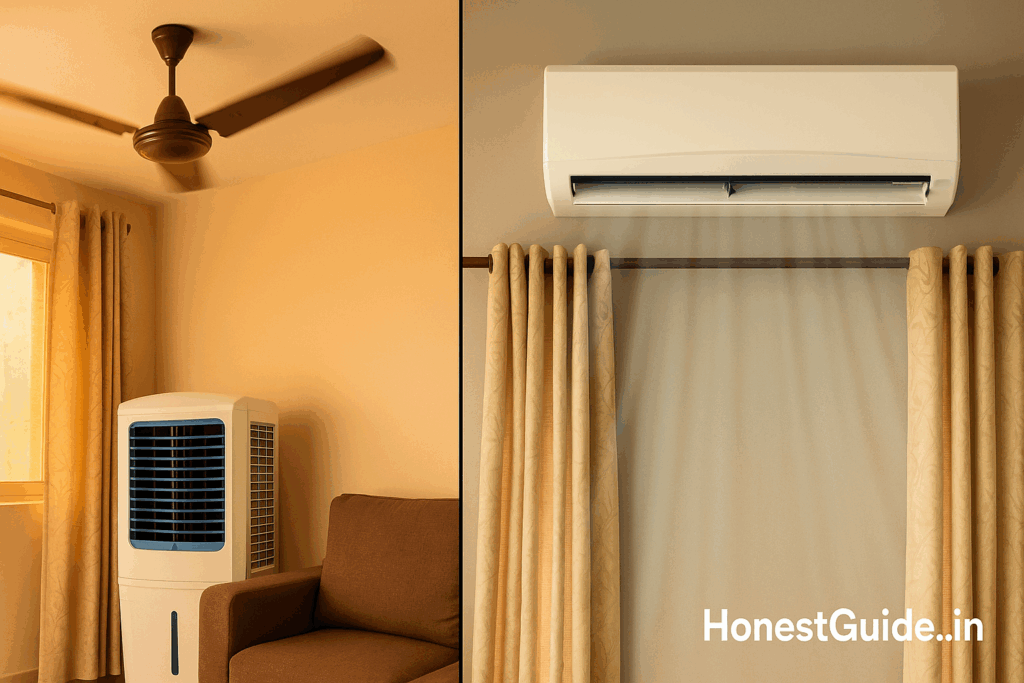
| What it does | Moves air; no temp drop | Evaporative cooling; adds humidity | Refrigeration; cools & dehumidifies |
| Best climate | Any (support) | Hot-dry climates | Any; especially humid/coastal |
| Windows | Open/closed fine | Needs windows slightly open | Closed room best |
| Typical power | 28–75W | 100–270W | ~0.8–1.8 kW (running) |
| Upfront cost | ₹2–4k | ₹5–25k | ₹32–55k (+ install) |
| Running cost | Lowest | Low-moderate | Highest (varies with ISEER & set temp) |
| Air quality | No filter | Adds moisture; simple filters | Filters + dehumidifies |
| Where it shines | Whole-day use, bills in check | Dry cities, balconies, living rooms | Bedrooms, peak heat, monsoon humidity |
| Labels to check | BEE fan label | Wattage/air-flow; reputable brand | BEE star + ISEER |
Sources: BEE label guides (AC & fans), manufacturer specs for typical wattage ranges. Beestar Label+2Beestar Label+2
🧩 Scenarios (pick your closest)
-
Renter in Jaipur (dry heat, 16 m² room, budget ₹10k):
Start with BLDC fan + personal/tower cooler (~120–170W). Keep a window ajar for cross-flow. Add reflective film/curtains. AC isn’t must-have unless nights stay hot. Symphony Limited -
Coastal Mumbai 1BHK (humid nights, street noise):
Cooler will feel clammy in monsoon. Go inverter split AC (1–1.5 ton) for bedrooms + BLDC fans for the rest. Seal leaks, set 24–26 °C, use sleep timer. The Times of India -
Top-floor Delhi, west-facing hall (22 m²):
Desert cooler can help pre-monsoon; but for evenings/monsoon comfort choose 1.5-ton inverter AC. Add awning/curtains; keep fan for circulation. -
Small town with frequent power cuts:
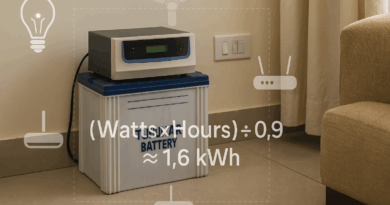
BLDC fans + inverter-friendly cooler (many draw ~100–200W) will run longer on backup. AC on backup needs robust inverter/battery. Symphony Limited -
Senior couple, allergy issues:
Prefer AC with proper filter + dehumidification; keep 26 °C setpoint and regular filter cleaning. Fans assist air movement without extra humidity.
⚠️ Pitfalls & how to avoid them
-
Buying a cooler for a humid city/monsoon.
Consequence: Sticky air, poor comfort. Fix: Use AC during humid spells; run cooler only in dry heat with windows cracked. The Times of India -
Ignoring BEE/ISEER on an AC.
Consequence: Higher monthly bills for years. Fix: Compare ISEER and star rating on the BEE label; pick the highest you can afford. beeindia.in -
Old induction-motor fans.
Consequence: ~2× energy vs BLDC. Fix: Upgrade to BEE-rated BLDC (28–35W typical). Beestar Label+1 -
Sealing the room while using a cooler.
Consequence: Rising humidity, less cooling. Fix: Keep fresh-air path. -
Oversizing/undersizing AC.
Consequence: Poor comfort or high bills. Fix: Match tonnage to m², insulation, and sun exposure; check brand calculators; err slightly higher for top floors.
🗣️ Mini-scripts (copy, tweak, use)
-
At an AC showroom:
“I’m cooling a [m²] room on the [floor] with [sun exposure]. Show me inverter splits with highest ISEER in my budget. What’s the annual kWh at 24–26 °C per your label?” -
At a fan shop:
“I need a BEE-rated BLDC fan around 1200 mm. What’s the wattage at full speed and the air-delivery (m³/min)? Any noise or warranty notes?” -
Buying a cooler online/offline:
“I live in a humid/dry city. What’s the wattage, air-throw, pad area, and tank size? Do I need windows open and how much?” -
Installer briefing (AC):
“Please nitrogen pressure test, vacuum to spec, and check drain slope. Mount the outdoor unit with clear airflow and use line-set insulation.”
📋 Quick checklist (paste into your notes)
-
City climate checked (dry vs humid)
-
Room size measured (m²) + sun exposure noted
-
Shortlisted: BLDC fan / cooler / inverter AC
-
Read BEE label (AC) / wattage (fan/cooler)
-
Ventilation plan (cooler needs fresh air)
-
Curtains/film/door-gap seals planned
-
Budget split: upfront vs monthly bills
-
Backup power: what runs during outages?
-
Service & warranty terms saved
-
Final: setpoints (AC 24–26 °C), fan speed, window routine
❓FAQs
What is ISEER and why does it matter?
It’s Indian Seasonal Energy Efficiency Ratio, the AC efficiency metric based on Indian temperature patterns. Higher ISEER = lower seasonal electricity for the same cooling. Check it on the BEE label. beeindia.in+1
Are BLDC fans really that efficient?
Yes. New BLDC fans can draw ~28–35W at full speed vs ~70–80W for older designs, saving significant units over summer. Look for the BEE fan label. Beestar Label+1
How much power does an air cooler use?
Typically ~100–200W (personal/tower) and ~150–270W (desert), brand- and size-dependent. Check the product page; several Symphony models list 165–200W. Symphony Limited+1
Why does my cooler feel worse in July–August?
Because humidity is high during the monsoon, evaporation slows, and the air feels damp. That’s when AC + fan works better. The Times of India
What AC setpoint saves money without feeling hot?
Most homes are comfortable at 24–26 °C with a ceiling fan on low; each degree higher saves units over time (and ISEER helps). Beestar Label
Is there a government label for fans too?
Yes. BEE star rating for ceiling fans is now part of the labeling scheme; check the star label and wattage before buying. Beestar Label
📚 Sources (official/primary & authoritative explainer)
-
Bureau of Energy Efficiency (BEE) — ISEER basics & AC star labels (Room AC schedules, sample labels). beeindia.in+2Beestar Label+2
-
BEE — Ceiling fans star-rating schedule (Schedule-8) and notes on fan labeling. Beestar Label
-
Crompton explainer — Typical ceiling fan wattage & mandatory star rating note (contextual). Crompton+1
-
Symphony (manufacturer) — Air cooler power consumption examples (165–200W). Symphony Limited+1
-
Down To Earth — ISEER context in India’s climates (recent explainer). Down To Earth
-
IMD (Monsoon reports/FAQs) — Humidity/season context affecting cooler performance. Mausam+1
Note: Prices, tariffs, and star-rating thresholds change. Always cross-check the BEE label and the official model page for current specs. This article is general guidance; it’s not personalised advice.